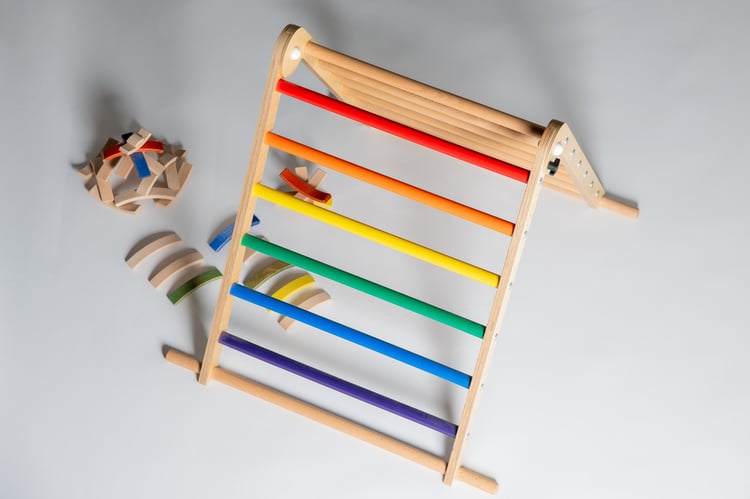
Wooden toys are better than plastic for brands that want simpler regulatory compliance, certified sourcing and components built to last. Solid wood does not depend on plasticizers or fluorinated additives, and it can be machined to tight tolerances, so the safety review concentrates on finishes and adhesives rather than on the base material.
That does not make plastic the wrong choice for every product. It makes wood the stronger default for a growing share of toy categories. Minelli Group has transformed wood into custom wooden toy components since 1937, and this guide explains why wooden toys are better than plastic from the manufacturing side.
Wooden toys vs plastic toys: what changes for a brand
| Criterion | Solid wood | Plastic |
|---|---|---|
| Chemical profile | No plasticizers or fluorinated additives needed. Review focuses on paints, lacquers and adhesives. | Relies on additives such as plasticizers, stabilizers and colorants. |
| Regulatory exposure | Same safety tests apply, with fewer restricted substance families to manage. | Directly affected by rules on phthalates, bisphenols and PFAS. |
| Durability | Can be sanded and refinished. Wear shows as patina. | Strong on impact, but can crack, fade or deform. Damaged parts are rarely repairable. |
| Sustainability story | Renewable, with FSC and PEFC chain of custody certification. | Mostly fossil-based unless recycled or bio-based content is documented. |
| Design freedom | Excellent for turned, milled and laminated parts. Limited for thin-walled, complex moulded shapes. | Excellent for complex geometries at high volume. |
| Tooling | No injection moulds. Lower upfront tooling for short and medium runs. | Injection moulds require significant upfront investment. |
Regulation is tightening on plastics and their additives
Toy chemistry is where the gap between the two materials is widening fastest. In the European Union, the new Toy Safety Regulation, (EU) 2025/2509, was published in the Official Journal on 12 December 2025 and repeals the current Toy Safety Directive on 1 August 2030. According to the Council of the EU, the new rules:
- extend the ban to endocrine disruptors and to substances that harm the respiratory system or specific organs;
- limit the intentional use of PFAS in toys;
- ban 10 bisphenols;
- require a digital product passport for every toy placed on the EU market, including toys sold online.
In the United States, all children's toys manufactured or imported on or after 20 April 2024 must be tested and certified to ASTM F963-23. The CPSC limits eight phthalates to 0.1% in children's toys and childcare articles, and caps lead at 100 ppm in accessible parts of children's products. Phthalates are plasticizers that make some plastics soft and pliable, so these limits weigh on plastic formulations far more than on solid wood.
Wood is not exempt. Paints, lacquers, adhesives and any plastic or metal inserts in a wooden toy must pass the same tests. The difference is scope: solid wood does not need plasticizers or fluorinated additives to perform, so the chemical review shrinks to the coatings and glues the manufacturer controls. Minelli uses child-safe water-based paints and finishes and engineers components to meet international toy regulations.
Durability and product lifecycle
Toys are dropped, thrown, chewed and handed down. Dense hardwoods such as beech and maple resist impact and wear, and a worn wooden part can be sanded and refinished instead of replaced. Plastic is strong on impact but can crack, fade or deform over time, and a damaged plastic part is rarely repairable.
For a brand, durability supports premium positioning and a longer life in the home. It also depends on specification. Species selection, moisture content and grain orientation decide whether a wooden component stays stable, and this is where an experienced manufacturer changes the result. Explore our solid wood capabilities.
Sustainability you can certify and communicate
Wood is renewable, and its credentials can be verified. FSC certification works on two levels: forest management certification confirms that a forest is managed responsibly, and chain of custody certification tracks certified material through processing, manufacturing and distribution.
For toy brands, FSC certified wooden toys offer a documented basis for the claims made on pack and in sales documents. Minelli works exclusively with FSC and PEFC certified wood from responsibly managed forests, and publishes a sustainability report every year.
Demand supports the case. Analysts value the global wooden toy market at roughly USD 26 to 31 billion in 2025, with forecast growth of about 4 to 6% a year, driven by parents looking for durable, non-toxic alternatives to plastic (GMI, Fortune Business Insights). Estimates vary by publisher.
What parents expect, and why it shapes your range
Parents are the end customer your retailers answer to. A University of Toledo study (Dauch et al., 2018) found that toddlers given 4 toys instead of 16 played twice as long and in more varied ways. The study measured quantity, not material, but it points to a design principle: simple, open-ended toys hold attention. Solid wood lends itself to forms that are open-ended by design, such as blocks, stackers and puzzles.
Where plastic still makes sense
Plastic remains the right material for some products. Bath toys, soft or flexible parts, very thin-walled shapes and highly complex moulded geometries are difficult to reproduce in solid wood, and electronic toys need housings that wood cannot always provide at high volume and low unit cost. Many successful toys combine materials. Minelli also develops materials beyond solid wood, which makes hybrid designs possible when a pure wooden solution does not fit.
What we offer when you move toy components to wood
Switching from plastic to wood changes the engineering, not just the material. Designs made for injection moulding rarely transfer as they are: undercuts, thin walls and living hinges need to be rethought for turning, milling and laminating. Here is what we bring to the project:
- dimensional accuracy and repeatability across every batch;
- certified wood and a controlled supply chain;
- child-safe water-based paints and finishes;
- product co-design to adapt existing plastic designs to wood, and fast prototyping to test them before production starts;
- scalable capacity, with five production facilities across Europe and the United States.
We work with toy brands on OEM solutions from the earliest stage of development, and we support design for manufacturing and feasibility studies for every new project. See more in our Toys magazine section.
Frequently asked questions
Why should toy brands switch from plastic to wood?
Brands switch to wood to simplify chemical compliance, support sustainability claims with FSC and PEFC certification, and offer durable products with premium appeal. Wood does not suit every product, so the switch works best when the component design is adapted to wood from the start.
Are wooden toys easier to certify than plastic toys?
Not automatically. Wooden toys must pass the same tests, including ASTM F963-23 in the US and the new Toy Safety Regulation in the EU. The difference is that solid wood needs no plasticizers or fluorinated additives, so testing focuses mainly on paints, lacquers and adhesives.
Are wooden toys more sustainable than plastic?
Wood is renewable, and FSC or PEFC certification verifies that it comes from responsibly managed forests. Plastic is mostly fossil-based. The overall footprint still depends on sourcing, finishes, transport and product life, so brands should rely on certified, traceable supply to support any claim.
What do we need from a toy brand to start a project?
The drawing or the existing design, the materials and finishes you have in mind, the target markets and regulations, and the expected volumes. With these, we plan co-design, prototypes and a production schedule.
Conclusion
Wood does not replace plastic everywhere, but for a growing set of toy categories it offers a clearer compliance path, certified sourcing and components that last. The decision works best when the manufacturer is involved from the first sketch.
Evaluating a switch to wood? Talk to our team about custom wooden toy parts for your range.