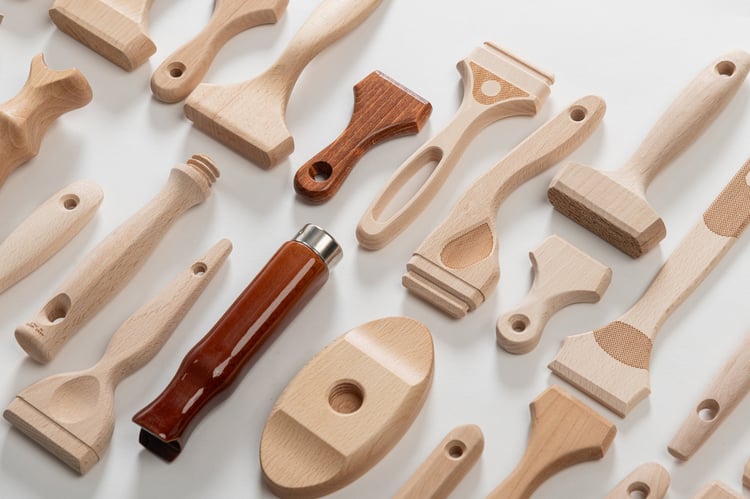
Wood is the right material for paintbrush handles when a brand wants a secure natural grip, custom shapes, finishes that can be engineered for water resistance and certified, renewable sourcing. It needs controlled moisture content and a good finish, which is why handle quality depends on the manufacturer.
Plastic is not the wrong choice for every brush. But for professional and decorating ranges, wood remains the traditional material. Minelli Group has transformed wood into custom components since 1937, and this guide answers a simple question, why use wood for paintbrush handles, then sets out what a brand should check before specifying brush handles in wood for DIY and professional painting.
Wood vs plastic paintbrush handles at a glance
| Criterion | Wood | Plastic |
|---|---|---|
| Grip and feel | Natural texture and warmth. Shape and finish set the grip. | Smooth unless moulded with grip features, which can be ergonomic. |
| Shape freedom | Turned, milled and sanded to custom profiles and lengths. | Complex shapes by injection moulding, with upfront tooling costs. |
| Water and solvents | Needs a finish and controlled moisture content. Prolonged soaking is the main risk. | Not affected by water. Suited to soaking. |
| Finishes and branding | Lacquers, water-based paints and oils in many colours and effects. | Colour is usually moulded in. Surface effects depend on the polymer. |
| Sustainability story | Renewable, with FSC and PEFC chain of custody certification. | Mostly fossil-based unless recycled or bio-based content is documented. |
| Cost | Often higher per piece. The difference is justified by the premium image of the product and by its performance. | Often lower per piece, especially at very high volumes. |
What a paintbrush handle has to do
A handle does four jobs. It gives the hand a secure hold, balances the weight of the ferrule (the metal band that joins the bristles to the handle) and of the bristles, accepts the ferrule with a precise fit, and resists contact with water, paint and cleaning.
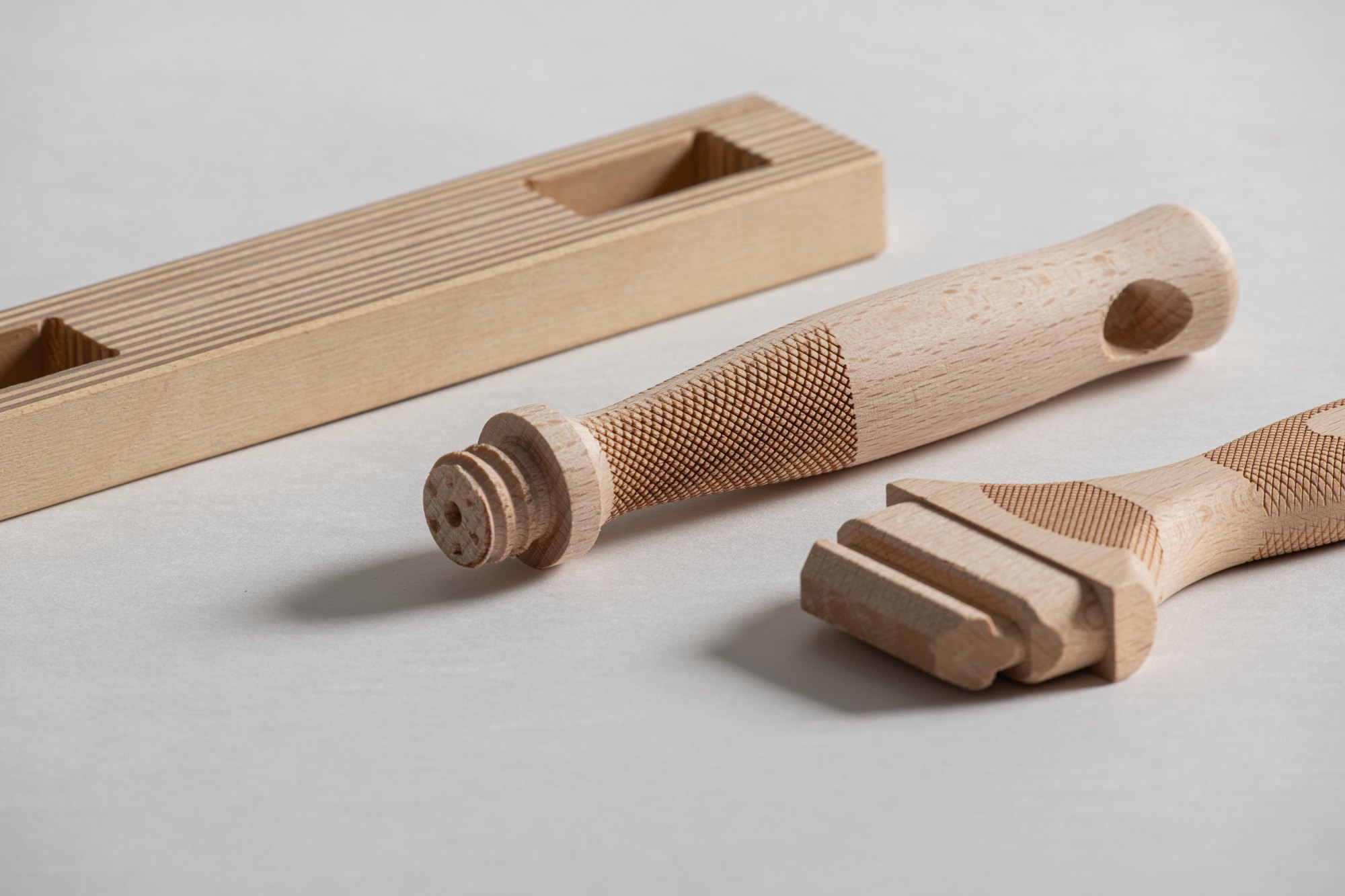
Weight and balance come from species density, shape and length. Beech is the species we use for brush handles, because it can be turned and finished to a smooth, even surface. Discover our knowledge of solid wood manufacturing.
Fit matters as much as shape. The part of the handle where the metal ferrule is fitted must hold the ferrule and the bristle head firmly across thousands of pieces. The handle's dimensions must be consistent from one batch to another. A fit that is a fraction too loose or too tight creates assembly problems on the brush line.
The moisture question, and how it is solved
Wood is hygroscopic: it exchanges moisture with the surrounding air. The USDA Forest Products Laboratory explains that moisture content tends to reach equilibrium with the humidity around the wood, and that protective coatings retard dimensional changes but do not prevent them. It also notes that when a wooden component is manufactured at a moisture content matching its service conditions, significant dimensional changes are not expected.
For a brush handle, that translates into four controls:
- drying the wood to a controlled moisture content before machining;
- choosing species and grain orientation for stability;
- finishes selected and applied to slow moisture uptake;
- testing finished handles for water exposure and cleaning cycles before approval.
No coating makes wood immune to water, and a handle left soaking for days will move, so we agree the real use case with the brand from the start, such as daily cleaning. On the finish, we use water-based finishes with reduced VOC content: they help us limit emissions and improve the safety of our production processes.
Handle shapes for different jobs
Shape follows use. Detail and trim brushes need slim, light handles for control. Larger brushes for walls and wide surfaces need handles that take pressure comfortably over long sessions.
We produce custom-made components, from new designs to products already on the market that we reproduce to your specification. We define with the customer the product specification in every detail, through product co-design, fast prototyping and design for manufacturing, so each profile is developed with the brand.
How wood helps a brush stand out
The handle is the part of a brush that customers see and hold first. A brand can control colour, gloss, texture and shape and own the handle design, instead of adapting a stock shape, to make a range recognisable on the shelf.
Certified sourcing you can communicate
FSC certification works on two levels: forest management certification confirms that a forest is managed responsibly, and chain of custody certification tracks certified material through processing, manufacturing and distribution. Independent third-party bodies issue the certificates. PEFC is a similar international scheme, with comparable aims.
For brush brands, FSC and PEFC certified wood gives a documented basis for the claims made on pack and in sales documents. Minelli works with both and publishes a sustainability report every year.
Where plastic still makes sense
Plastic remains the right choice for some brushes. Brushes left soaking for long periods, budget ranges, disposable brushes and handles with moulded multi-material grips are easier to make in plastic. Many brands run both: wood for premium and professional lines, plastic for high-volume entry ranges.
Developing a new brush range? Talk to our team about custom wooden handles. Our capacity grows with your volumes, across five production facilities in Europe and the United States.